
Does Borax Kill Creeping Charlie? (What You Need to Know)
Using Borax for Creeping Charlie has long been suggested as a DIY remedy for this weed, especially as part of older homemade weed killer formulas.
However, later testing and extension guidance have raised concerns about inconsistent results and potential damage to grass when it is not applied carefully.
In this article, we’ll look at how the original borax formula was used, learn whether it actually kills Creeping Charlie, why recommendations have changed, and what safer alternatives are available for long-term control.

What is Creeping Charlie?
Glechoma hederacea, also known as Creeping Charlie, Creeping Jenny, or ground ivy, is a common invasive plant that can ruin the look of your lawn.
- Creeping Charlie is an aggressive, low-growing perennial
- It loves to live and spread in shady, moist areas.
- This plant is a member of the mint family and has a slightly aromatic scent
- It spreads through its seeds and also its vining stems, which root at their nodes
- The leaves of creeping Charlie have a distinctive coin shape with rounded, toothed edges
- It can move out of the borders and invade the lawn
Does Borax kill Creeping Charlie?
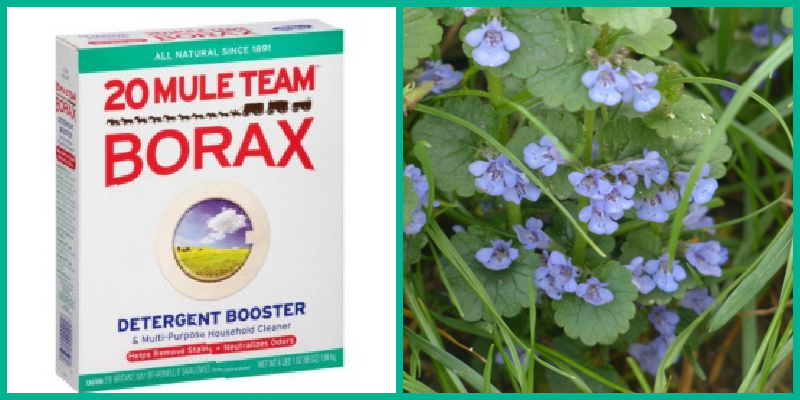
Does Borax Kill Creeping Charlie?
Borax can suppress Creeping Charlie in some cases, but it does not reliably kill it, and results are inconsistent from lawn to lawn.
Borax (sodium borate) affects Creeping Charlie’s plant metabolism by disrupting boron balance, which can stunt or injure broadleaf weeds. In practice, this means you may see temporary browning or weakening of Creeping Charlie after application.
However, several limitations matter:
- Inconsistent control: Some patches may be affected while others recover quickly.
- Selective risk is poor: Borax does not target Creeping Charlie specifically, so it can also stress or damage surrounding turfgrass.
- Regrowth is common: Even when top growth is damaged, underground runners often survive and spread again.
- Soil sensitivity: Boron can accumulate, which means that repeated applications increase the risk of long-term lawn injury.
Why Borax is no longer recommended for Creeping Charlie
- Excessive amounts of boron can damage and even destroy lawns.
- There are concerns about how long boron remains in the soil and its effect on nearby plants.
Bottom line: Borax may temporarily weaken Creeping Charlie, but it is not a consistent or reliable weed killer, and it carries a real risk of harming your lawn if misused.
Because of these issues, extension guidance and later testing (including university research such as Iowa State’s follow-up findings) have moved away from recommending borax as a dependable lawn treatment, and I no longer recommend it.
The old Borax weed killer formula

This borax weed killer formula for Creeping Charlie was originally shared from the Iowa State University website and was commonly used by gardeners in the past. Their updated guidance now notes that Borax is not recommended for lawn use due to inconsistent results and potential turf damage.
Although the formula is no longer recommended in lawn settings, it is a useful spot-treatment for weeds in hardscape areas such as cracks in driveways and walkways.
Original formula
- 10 oz. Twenty Mule Team Borax
- 4 oz. warm water
- Mix well and then dilute in 2.5 gal. water.
- Apply carefully as a targeted spot treatment (not as a lawn spray)
Safer alternatives for Creeping Charlie control
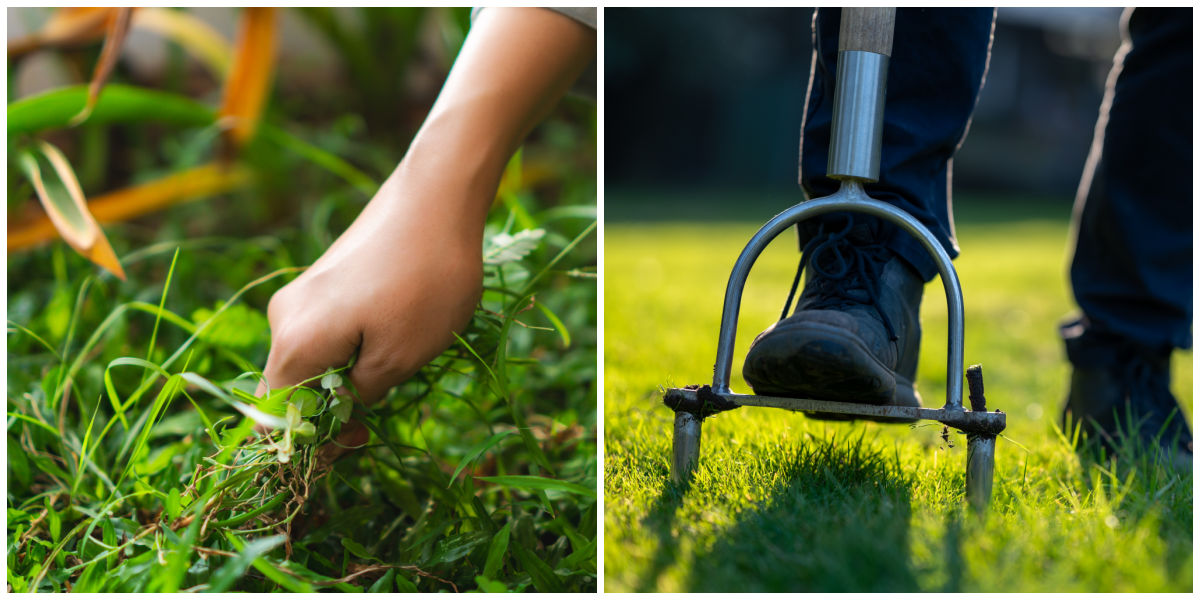
If you prefer not to use borax for Creeping Charlie, or are looking for methods currently recommended by extension services, there are several more reliable control options.
- Hand pulling: Most effective when the soil is moist. Best non-chemical option, especially for small infestations.
- Selective herbicides (triclopyr): Products containing triclopyr are widely recommended for Creeping Charlie and are most effective when applied in the fall.
- Iron-based treatments: Chelated iron products can temporarily damage Creeping Charlie without harming turfgrass, but repeat applications are often needed.
- Smothering (garden beds): Use cardboard or newspaper covered with mulch to block light and kill patches in non-lawn areas.
- Improve lawn health: Creeping Charlie thrives in thin turf. Thickening grass through overseeding helps prevent reinfestation.
- Reduce moisture and shade: Improve drainage and prune trees to increase sunlight and reduce ideal growing conditions.
- Aeration: Annual core aeration helps relieve soil compaction and supports healthier turf growth that can outcompete weeds.
Share these recommendations about Borax for Creeping Charlie on X
If you enjoyed learning how Borax affects lawns, why not share this post with a friend?
🌿 Does borax actually kill Creeping Charlie… or is it just another DIY lawn myth? Some gardeners swear by it, but newer guidance raises concerns about inconsistent results and possible lawn damage. Find out what you need to know… Share on XPin this guide to Borax for Creeping Charlie
Would you like a reminder of current thinking on using Borax for Creeping Charlie weeds in your lawn? Pin this image to one of your gardening boards on Pinterest so that you can easily find it later.
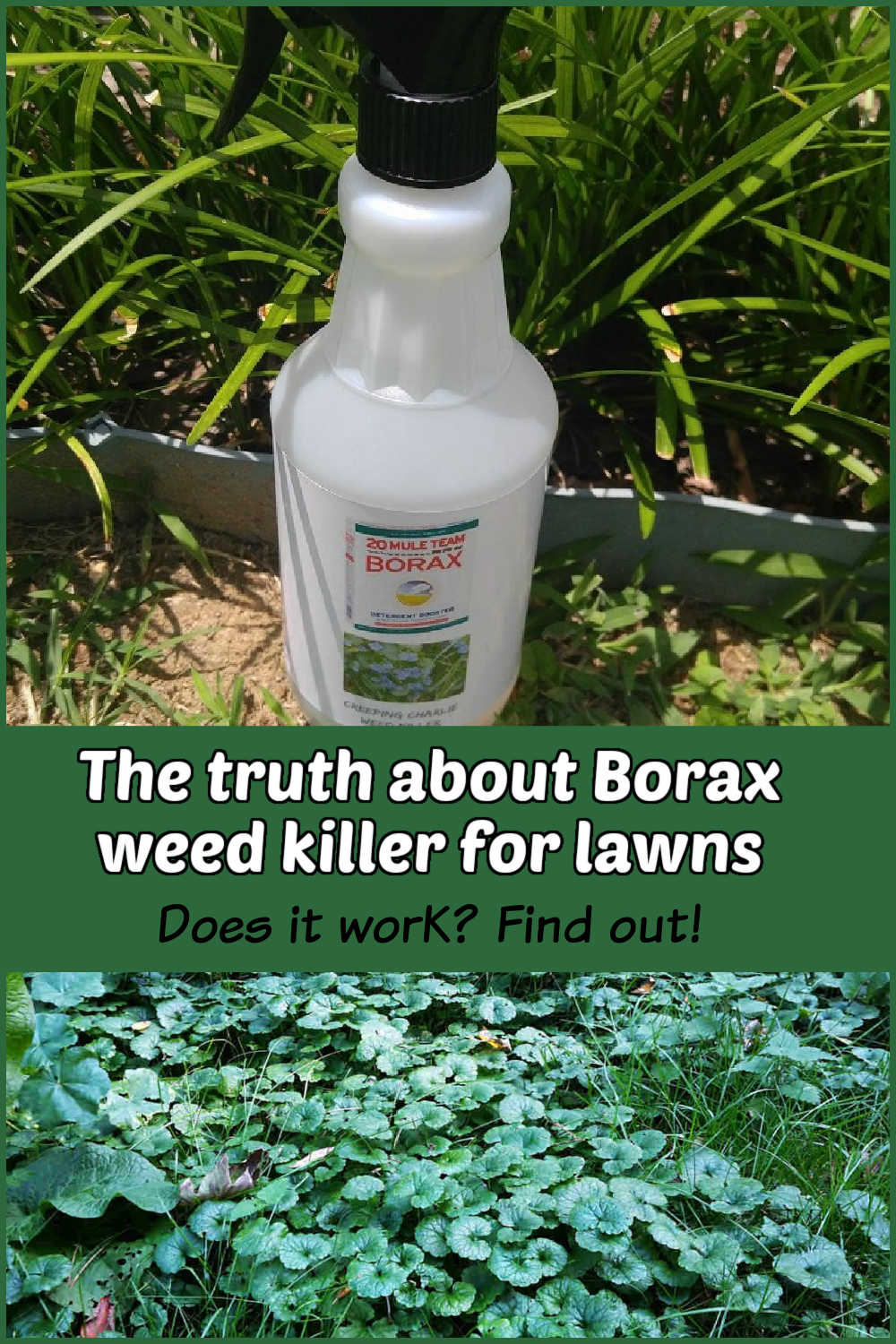
Admin note: This article was originally published in June 2017 and has been updated with new photos and a printable how-to card. It also reflects updated information regarding the use of borax for Creeping Charlie, including current concerns about its effectiveness and potential impact on lawn grass.
Original Borax Weed Killer Formula (Creeping Charlie)

This older formula has been widely shared for Creeping Charlie, but is no longer generally recommended for lawn use due to inconsistent results and potential turf damage. It is a good weed killer for hardscape cracks and weeds in driveways.
Materials
- 10 oz. Twenty Mule Team Borax
- 4 oz. warm water
Tools
- Bucket
Instructions
- Mix the Borax and warm water till well combined.
- Add this mixture to 2.5 gallons of water.
- Use a spray bottle to treat weeds in cracks and driveways. (No longer recommended for lawns).




This is a great post Carol! You obviously know a lot about this subject as this is very informative to read.
Natural weed killers are important, and finding natural alternatives for the garden is something we should all focus on more.
Thanks for providing the amounts to make this weed killer, it’s just got to be scaled down now!
Again, thanks for the brilliant read Carol.
Thank you for the nice comment Kevin. I’l glad you enjoyed the article. Carol
Is the borax weed kill ok to use by my evergreen juniper???
the weed killer is meant for lawns. According to the U.S. Forest Service, borax spilled on or applied to cropland or growing plants may kill or seriously hinder growth. It is unlikely that once a tree is established, borax application will kill it, but the tree may die if borax is continually applied.
@Chris Krogerson, At the rate for killing creeping charlie and not sprayed directly on the Juniper it should be fine to use once or twice over a year or 2. Boron does not leave the soil quickly so repeat applications will increasingly risk killing more types of plants and those with deeper root systems even if used several years later. A downside of boron is you can render the soil unsuitable for various plants for a very long time if you spray excessively before realizing it and boron is slow to work.
If you still have new creeping charlie show back up 6-12months later odds are you have not reached the point the amount in that area of soil is toxic to trees, most bushes, or grass. Flowers and vegetable plants vary more in sensitivity.
If you see browning or yellowing of leaves on larger or spreading plants do not treat the whole area again even if there is some creeping charlie. You may have excessively treated other nearby soil that is impacting a plant with a broader root system. It may be safe to spray only where the remaining creeping charlie is but to avoid the risk of over applying boron to the area it’s better to manually remove the remainder once you’ve reduced it’s ability to spread faster than you can get rid of it. You can also try spraying some vinegar with a little dish soap carefully only on the leaves of what you want to kill to finish eliminating it.
How much Borax is 10oz?
I didn’t measure it, I weighted it on a digital scale.
I can’t dissolve 10 oz powder in half cup of water… that’s too much to even make a paste. Are you sure on the ratios? 10 oz is about 2/3 of a pound.
Yes, the ratios are correct. It’s 10 ounces in 1/2 cup. This paste is THEN dissolved in 2 and 1/2 gallons of water. CArol
I measured it and it’s just shy of 1.5 cups plus a 1/3 cup or 1.83 cups
I found a conversion site that states 0.69 cups equals 10 weighted ounces of (search term) “Borax granular”. I too find this “recipe” confusing with the incongruent units of measure.
https://www.aqua-calc.com/calculate/weight-to-volume
Ounces measure weight or volume so it is just meant to be confused. a liquid ounce or a weight of mass? can we just use a metric measure so to be less confusing? This is setting people up for failure. 1 ounce by weight is way different than one ounce by volume.
I’m too lazy to dig out my supplement scale and measure it. According to a calculator for weight and volumes that specifically lists boarax: 1 ounce is 28.35 grams or very slightly over 1 tablespoon. At smaller quantities you can use 1 tablespoon per ounce needed in both US and metric. At 10 ounces you need 11 tablespoons to make up for the loss per tablespoon and you’ll be within about .03 ounces of 10 ounces. For larger amounts you should probably use a scale to get an accurate mixture.
It will not dissolve neatly in the small quantities of water recommended. Don’t even bother. You will be there forever squishing lumps in an attempt to get an even paste and stirring it around repeatedly to spread the water to all the powder. Due to it’s tendency to clump in larger quantities or cooler water it’s normal to premix a paste before adding to a larger quantity of solution when making concentrated cleaners but when dissolving to go through a sprayer in such a low concentration it’s not at all necessary.
Use HOT water and don’t mix a lot at once so it can’t solidify into a solid lump. I put a few inches of hot water in a 1/2 gallon container with extra air space over the top mark, add 2 ounces of borax, fill the rest of the way with hot water, and shake thoroughly. It dissolves pretty much immediately.
Now if you dump an entire cup of borax into any quantity of water at once it will promptly stick to itself and form an outer layer that never shakes or stirs apart. Especially in cooler water. Use as hot of water as you can but don’t actually boil the borax and mix a few ounces or tablespoons at a time in order to dissolve it easily without having to make a paste first.
Thanks for this great article. Never had this in my lawn but this year I noticed seedlings growing up in my beds. Since it’s a pretty leaf thought I’d let them grow. I will now go out and promptly eradicate. Huge and timely thanks.
Hi Carol I often see weeds that are pretty and am tempted to leave them but they can be invasive! Carol
does borax killby spraying it on the plant and then being absorbed or spraying it on the ground and taken up through the roots?
In my experience most weed killers work by moving from the leaves through to the roots under the plant. Carol
Hi Carol, I have used the vinegar formula without success so I will give your formula a try. One question, is it harmful to small animals(cats and dogs)?
Hi Bob. Borax powder is known to be toxic around pets so I would be careful of using even a diluted formula around them if they are likely to chew on the grass and weeds. Vinegar and boiling water are the only weed killers that I know of that are safe, but both are not selective and will kill everything you put them on. Carol
Bob Henbrey, for most weeds, you need 2 things for vinegar to kill. 1) Lots of sunlight. 2) About 3 to 4 TABLEspoons of dish-washing soap per 1 gallon of vinegar. The vinegar will just fall off of most weeds’ leaves unless you mix the soap in it.
how long do you have to wait before letting your dog in yard treated with borax formula
Hi Mary. I don’t recommend using Borax weed killers around pets. Vinegar weed killer is the only homemade weed killer that I believe is safe around dogs. Carol
have heard sunlight grandular and borax work on Charlie-your thoughts???
Hi Donald. I have never tried this combination so I don’t know how it would work. Carol
explain granular sunlight?
Any idea if borax will work in ground cover? We have large beds of eounymous coloradus that has been invaded by creeping charlie/creeping jenny & wondering if anyone has experience as to whether borax will also kill the coloradus?
Thanks.
Hi Jim. I would be careful using the weed killer in garden beds. Borax can easily kill perennials. Grass is tougher but even on lawns, once must be careful of the dosage. Carol
Thanks for the label!! 🙂
So if Borax is toxic to dogs and cats, is it also toxic to rabbits and other wild life? If so, does that make it any better than chemicals?
Having nature take care of things naturally is optimal. Borax provides a LESS toxic and cheaper option than chemical fertilizers. I always err on the side of caution when talking about its use around any animals. Carol
Carol, I need help with calculations. I have a 20 gallon hose end sprayer. What setting do I use for the borax treatment?
And, do I use all 2.5 gallons of pre-mixed solution per 1000 sq’ or just one fill of the hose end sprayer per 1000 sq’. It is a Green Cross hose end sprayer and it runs from 2-60 on the dial. I am new to this.
Hi Melissa I have never used this formula in a hose end sprayer so I cannot tell you the settings to use. I just mix mine in a large bucket and use it over the 1000 square feet.
This formula will treat 1,000 sq. feet: (Don’t use it on a smaller area, or it will be too strong.) For use on established lawns.
10 oz. Twenty Mule Team Borax
4 oz. warm water
Mix well and then dilute in 2.5 gal. water.
Carol
How soon after applying the borax recipe can you reseed the lawn??????
Hi Dagmar. I’m afraid I can’t answer that question since I have not tried to reseed after using the weed killer. Carol
Carol – I was thinking of applying the Borax once this Fall (October?) and again in the Spring (April?). I live in Connecticut. Does this sound right?
PS – my lawn is covered with ground ivy.
Hi James. The weed killer should be used in the fall a couple of weeks apart. Carol
Hi Carol:
I just some in a small patch last Friday. Today is Wednesday. I see no evidence its working. No browning of the ivy at all. Still looks pretty healthy.
I used 5 teaspoons of Borax to one quart of water.
What am I missing?
Hi James. Your measurements are in different variables than the recipe that I posted, so I’m not sure if it is weaker than the formula. My formula from the University of Iowa is
This formula will treat 1,000 sq. feet: For use on established lawns.
10 oz. Twenty Mule Team Borax
4 oz. warm water
Mix well and then dilute in 2.5 gal. water.
Carol
Thanks Carol. I will wait til spring to apply. Should I apply at a certain air temperature? Also – does rain adversely affect the application?
Hi James. The most effective results come from using a weed killer when the temps are dry and when it is the active growing season. Rain will dilute it so it should be used when you don’t expect rain. Carol
Carol, you said to apply in the spring, but other sites suggest spraying in the fall after the growing season. I have 3-4 acres of Creeping Charlie
Hi Claudia. Thanks for pointing this out. I use most weed killers when weeds are actively growing, but checked again on the University of Iowa (where I got the recipe) and they do say fall for broad leaf, so I have amended my post. Carol
Carol, I have read that some people have a hard time mixing the borax. I used my stick blender and it only took about 30seconds. That may help someone else
Thanks for the tip Claudia. I will add it to my post. Carol
I can only find Borax in granular form…….any different recipe for this ?
hi thank you for the information on creeping Charlie I have it thick mixed in with my bushes in my flower bed how do I use this formula with that problem? Thanks very much I need help.
Hi Ruth. That is a hard one. The mixture would be fine to use in the lawn, but using it near bushes or in flower beds is not recommended, since it could damage those plants. Hand digging is the only recourse, I’m afraid, but it is hard to get it all. Carol
I want to clear an area of mostly grass in So. Tex. Think 20 MTB will work? Thanks!
Jack
I’m not in the position to advise specific use on the dosage for areas of the country. The recipe is one which has been shared from the University of Iowa.(link in article) Perhaps they can help you with specific questions on use in Texas.
What is the mix ratio for the vinegar and water alternative since I have pets and am unable to use the borax?
Hi Barbara. I’ve only made this mix using Borax. You may be interested in this post for a vinegar weed killer, but it is a general weed killer, not one specifically for Creeping Charlie, so it possibly kill surrounding grass.
I use straight vinegar sometimes add a surficant such as dish detergent but have good success with straight vinegar. The grocery store stuff is too week, I use 20% or 30% bought on line, (Amazon is one source). It is not selective, spray only what you want to kill. It will not kill the roots, the above ground part will die but most plant roots will put up new shoots so repeats are necessary until the roots are exhausted.
I tried putting it in a blender, but the borax still sank to the bottom. What is going wrong?
Hi Abraham. I’m not sure why it is doing that. I didn’t use a blender (a reader suggested this) I just mixed mine by hand and it dissolved fine.
I have been trying to mix 10oz (by volume, not by weight) of borax with 4 oz of water for literally 3 days and I cannot get it to mix. It just keeps settling to the bottom like a fine sand. I have given up.
Chuckers, I’ve tested the amount by volume an the amount by weight, which in this case is very close to being the same amount ( This is by luck only that this happens. Place the 10 oz. in a quart of hot water and stir intermittenly until it all dissolves, this takes awhile, but it will mix finally. mix this with approx. 2-1/4 gal. water.
I really need a solution for this weed because even the Ortho weedkiller is useless.
But I found an article in Star Tribune:
“Borax is no longer recommended by the University of Minnesota Extension. Borax, too, is a chemical. Use it more than twice to fight creeping Charlie, and it will kill your grass as well — lingering in the soil, and creating a dead zone where nothing else will grow.”
Hi Anil. Thanks for this update. The formula is still suggested on The University of Iowa’s website, so I am not sure which of them is correct.
This is why I pay little attention to university extensions. I have rarely ever gotten any good, usable information from them. It’s all theory. They rarely ever try what they preach to see if it really works.
I used your formula but my borax did not form a paste, it set up hard, what gives?
It sounds like you got the ratio of borax to water in a different ratio. The ratio is 10 oz of Borax to 4 ounces of warm water and then dilute this mixture in 2.5 gallons of water.
Tried 10 oz borax by weight, no way will 4 oz of water make a paste
Hi Bud. I didn’t try to make a paste. I just combined the 4 oz of warm water with 10 oz of Borax and then diluted it in 2.5 gallons of water.
@Carol, why can’t you just mix the borax with the 2 1/2 gallons of water instead of the 4 Oz of water?
It was the way the University of Iowa had it listed on their website so I used their suggestions.
I had creeping charlie at my former home. I ripped and kept ripping it out. Problem was it was in the neighbors lawn on the other side of the fence. I did get it out of my yard and had to keep up on what creeped under the fence. Boy does this plant stink. I now have found it in my new yard last year. Since my yard is now 10x’s bigger I will try the Borax.
How much mixture for about 10 sq ft. I have small lawn.
As mentioned in the article above, the mixture is not recommended for smaller areas, since it would be too strong.
This is an undervalued plant. It is edible – and medicinal. It contains trace minerals that many people are deficient in. Being in the mint family it has many uses in the kitchen. Creeping Charlie – if you can’t beat it – eat it!
Why mix with 4 oz warm water first? Why not just mix with 2.5 gal of water?
I’m not sure why. This is the formula that the university of Iowa suggested.
I incorrectly mixed my batch and had put it on the lawn already I had 1 cup extra of water .Will this decrease the effect of the borax on the plants?
Changing the recipe will change the effects.
RE: “If you cant beat it, Eat it!” 🙂 Creeping Charly recipe
Carol, I see that you suggest applying in the fall but can you apply in the spring?- Gary
Grass is stronger in the fall, so applying it in the spring may be more harmful to grass that is just starting to grow again.
Will plain borax powder work?
I’ve only tried this formula with Twenty Mule Team Borax so I can’t comment on its effectiveness with other Borax powders.
Just tried your Borax recipe and sprayed my weeds with a garden sprayer which held the whole 2.5 gallons . Now I’ll wait ’til those pesky weeds start to show signs of dying . Should I have mowed before applying?
Thanks for a great tip.
I’m not sure about mowing first. Iowa State University suggests apply the Borax weed killer when the creeping Charlie weed is actively growing in the fall. They say to choose a day when no rain expected for at least 48 hours. Then repeat two weeks later.
Carol, tried the borax for creeping charlie. It rained a day after I applied , so first results were non existent . Tried again following week, this time i didn’t try to mix with the 4oz. water first, just mixed gradually into the 2.5 gal’s. of water. Mixes much easier that way. Anyway, again it rained right after application. Being as it’s June, should I wait ’til the fall and try again. So far this is a washout as far as any results are concerned??Please let me know. thanks.
It’s hard to say how much of the mix will still be not washed away after the two rains. If it were me, I would wait, so as not to damage the lawn.
@Carol Speake, Thanks Carol, Frankly, I’ve given up on this working on the “infestation” that I have. The weeds don’t seem to be even mildly affected by this mixture!? Could it be that I have a “super mutation of Creeping Charlie” and it’s impervious to Borax??
I’m really not sure John. I made the formula and it worked on my creeping Charlie. Iowa State University has a website that I shared the formula from. They might be able to answer more specific questions.
Hi Carol;
Just wondering if you have tried using this Borax solution to kill goutweed? It’s also known as Bishops weed or ground elder. I have the solid green leaf variety and it chokes out everything in sight! any tips would be greatly appreciated.
With regards to pet toxicity; how long after application is it safe to put dogs back in garden?
Hi Mary, I have not tried this solution for goutweed, so I can’t comment. As to the toxicity, I would not use it where pets are present. I don’t have any idea when it would be safe to let them back on the lawn and would not take a chance.
not to be nitpicky but your article and comments refer to the University of Iowa when in reality it is Iowa State University.
Thanks for alerting me to my error. I have fixed the mention and my comments.
I came to this article to research methods to kill lawn for creating more pollinator plantings. I saw your lovely photos of the creeping charlie and wondered, why would you want to kill that delightful flowering plant? It has both pretty leaves and a sweet flower. It’s funny to me that you would want to get rid of that for a monotony of turf. To each his own! And thanks for your information!
does it have to be twenty mule team borax or borax i got walmart.thanks
Any Borax should do as long as the ingredients match the 20 mule team formula.